Showing posts with label test. Show all posts

Thursday, December 7, 2017

The Importance of Rhyming!


Rhyming is a key part to understanding our English language. In recent years we have become aware that rhyming may be more important than we once thought. Studies have shown children who are unable to rhyme may have a greater chance of having other reading difficulties such as dyslexia.

Rhyming is a skill which is learned. It is not a natural innate skill we are just able to acquire. Some are able to catch on quickly while others struggle. Practice and exposure is the best way to fully understand the key to rhyming. Rhyming is an auditory skill and something that children need to hear, therefore you should use the spoken words or pictures and not just printed words.

Teaching rhyming can be a lot of fun. One of the best ways to introduce and teach rhyming is with poems. Children in many cases will not notice the rhymes until you start pointing them out. There are also a number of great books for teaching rhyming such as; Rumble in the Jungle [Giles Andreae, David Wojtowycz], Double Trouble In Walla Walla [Andrew Clements, Salvatore Murdocca], and Edward the Emu [Sheena Knowles, Rod Clement] for a start.

Other ways you can provide the students practice is to give students each a picture or pin one one and have them find their rhyme partner. Tell each student a word as they line-up and have them tell you a rhyming word back. Picture sorts are always a great learning tool and children enjoy. If you are looking for picture cards here is a place to start: Rhyming Pictures


Tuesday, December 5, 2017

Almost Winter Break!

I found this image showing the phases of first year teachers during their first year. I think we have all had those feelings, I know I have and always look forward to break and the second part of the year. Only a few more school days and relaxation time! You'll be refreshed to tackle the rest of the school year, but who's counting?

(I didn't find who created the chart, but thank you.)

Monday, November 6, 2017

Building Student Engagement!


A few "think-abouts" when you are providing instruction to a group of students:

  • make sure you have your students attention before initiating instruction
    • use a signal
  • pace the lesson to maintain students attention
    • keep the lesson moving
    • use pair share
    • have group responses
    • be ready
  • maintain close proximity to students
    • be up and moving around the room
    • don't sit at the computer or document camera
  • transition quickly between tasks
    • know your routines
    • have materials ready 
  • refocus off-task students to the lesson focus
    • make sure you have stated your expectations
    • make them want to engage with you

Thursday, October 12, 2017

Reading - End of Unit Test -- Why Give Them?

  Barmina Iva ID 1883171 | Dreamstime Stock Photos

I met with a teacher who was very frustrated that she had just given the end of the unit test and all her students did poorly. She stated the test was a waste of time because when she went back and reviewed the the test she felt it did not cover what the unit had been covering. Have you been there? I have too!

The end of unit tests are an applied reading test covering more than just what was covered in the unit taught. They are asking the students to use skills taught in previous units of the program to check whether the students are able to retain previously taught skills and apply them. These tests are testing the students understanding not evaluating your instruction.

Within the program there are often section tests where you are able to check for understanding of the skills just taught. These are very useful for knowing if your students are understanding what you are presenting. We also often make the assumption they understand the skill but these tests do not allow the students to apply the information like in the end of unit test.

The big question then is why give these tests? We are able to gain a great deal of information from the students’ performance on these tests. If they were able to pass their section tests but not the end of unit test, they are able to perform the task but not apply that task in a different application. They also give us a view of their cognition, showing if they are able to retain the information or recall it when needed. These tests are also a great indicator of whether or not a student will be able to pass the state test. It has been shown by the publishers that if the students are able to pass these end of unit tests they are highly likely to meet or exceed on their state test. Therefore, they are a great predictor of how your students will do come state testing time.  

Use those tests as a teaching tool once you have given and scored them. Have the students make the corrections and discuss each of the sections. This will help build understanding of how to apply information which the students had indicated they are struggling to understand. Have the students retake the test or the parts they failed. Not to change their grade but to allow them to understand and comprehend the information. I can assure you by taking the time to use the test as a teaching tool you will see great results on the upcoming end of unit tests.

Wednesday, September 6, 2017

Rapid Letter Naming (RLN)

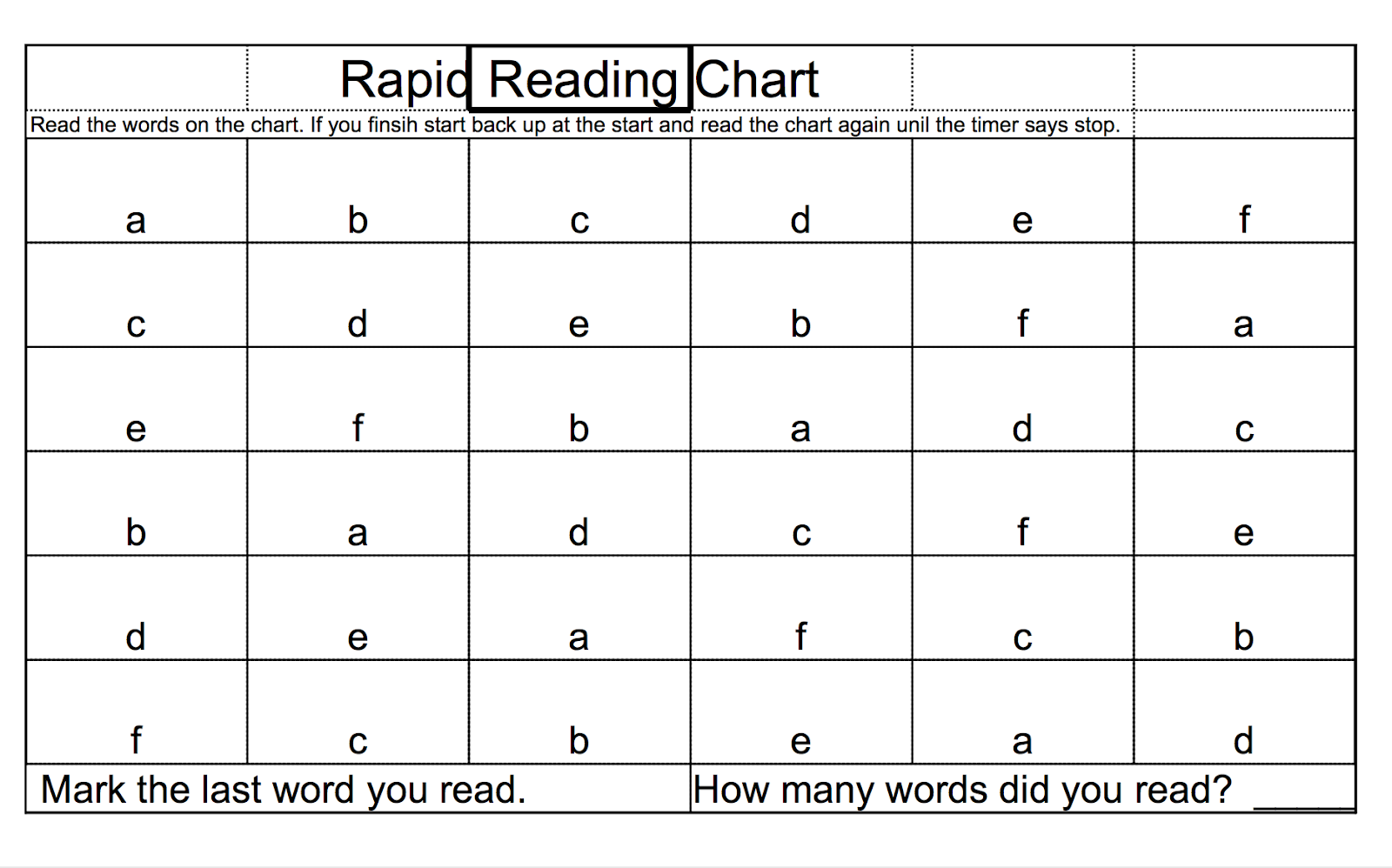
Rapid Letter Naming (RLN) has been proven to increase our ability to comprehend (Brain Connection, 2017) RLN is connecting visual and verbal information quickly without having to use cognitive energy to speak the written symbols.  Young children begin this process first by listening, then speaking, and finally visually, starting with environmental items such as “glass,” “dog,” “house.” Then adding pictures, next phase is moving toward reading. The brain has to be taught rapid automatic recall. This can be started by naming pictures quickly and then moving to naming letters (Brain Connection, 2017).  The objective is to train the brain to automatically recall using metacognition rather than just cognition. Building this skill in kindergarten and first grade will then allow the student’s brain to transfer the skill to reading words.
Below is a chart and link for you to create your own RLN sheet for students. If you replace the first row the rest of the chart will adjust. You are able to create charts for the letters your students are struggling with or create word-reading charts.  Make sure you post how you use the chart. We can all benefit from each other’s ideas.
Screen Shot 2017-09-06 at 8.45.49 AM.png
 

Brain Connection, 2017 (9/6/17), https://brainconnection.brainhq.com/brain-teasers/rapid-naming/

Tuesday, April 25, 2017

T's of Teaching


Time-Texts-Teach-Talk-Task-Test


TIME:
      Reading and writing should be the time priority getting at least 50% of the day's time.
      The other 50% of the day's time could be spent on other subject areas, such as social studies, math, and science.
      In many classrooms reading and writing are not the priorities which produces less proficient readers.
      In the classrooms where reading and writing are being given most of the day's time, more proficient readers are being produced.
      A good way to incorporate more reading and writing into the class time and keep the subject matter content is to have the focus or topic of the reading and writing projects be of science, social studies, and other time consuming subject matter.

TEXTS:
Student need a consistent, rich supply of text with appropriate complexity:
      Doing so will promote higher success rates in their reading proficiency.
      Teachers need to focus on grade appropriate vocabulary.
      Teachers often have to go against organizational grain and buy books themselves that are not state issued - this further benefits their students because not all books are suitable for lower performing students.
      By doing so, these teachers actually accelerated their students reading levels.
      Students can't only receive appropriate reading materials when they qualify for special instruction because some that don't qualify also need help.
      STUDENTS NEED CONFIDENCE AND MOTIVATION

TEACH:
Assign and Assess vs Modeling
      Modeling, demonstrating, and giving examples- provides new learning for students, teaches strategies gives instruction to know how to do something.
      Assign and assess- the teacher assigns the work and expects the students to complete it independently, there is no new learning involved.

Useful teaching strategies :
      decoding, composing, self-regulating as separate lessons to the whole class, to targeted small groups and to individual students as side by side instruction.
      Teaching requires knowing not only how to teach strategies explicitly, but also how to foster transfer from the structured practice activities to independent use.

TALK:
Classroom talk allows the students to process the information in their own words:
      should be encouraged within the classroom - teacher -student and student- student.
      should model and encourage purposeful discussion, that offers problem-posing, problem- solving related to subjects.
      needs to pose questions that are open-ended thought provoking.
      should use classroom talk to discuss ideas, concepts, hypotheses, strategies, responses with others by both teachers and students.
      should have questions that are open-ended  where multiple responses would be appropriate, not just one right or wrong answer. This helps students share ideas and experiences - helping them create a positive learning experience.
      leads to improved reading comprehension.
      is still under researched.
      effective classroom talk should not be interrogational and only have one correct answer.

TASKS:
      In the classroom there is an emphasis on the greater use of LONG ASSIGNMENTS.
o   Not so much centered around multiple, shorter tasks.
o   Example: Students often worked on a writing assignment for ten days and not just in one sitting.  Read entire books and did group research projects.
      Work completed is more substantial and challenging to the students.  The work was more self regulated.
o   Students seemed more on task due to complex tasks
      The students also had a choice in the assignment that they were doing. (managed choice)
o   Focused on one topic. Students did similar but different tasks. Example: insects- students were able to choose their insect.
      These types of student choices have been documented to show that students have a greater ownership in their work and a greater engagement.

TEST:
Achievement based grading
       the best performances get the best grades
      traditional type of test
      higher level students don't have to put forth much effort to get good grades

Rubric-based evaluation
      measuring from where students started to where they are now
      earning grades is students responsibility
      gives students information needed to improve grades
      teachers must really know their students
      little test preparation activity, instead teachers rely on good instruction to enhance test performances

The bullet points were taken from Allington’s article, What I've Learned About Effective Reading Instruction FROM A DECADE OF STUDYING EXEMPLARY ELEMENTARY CLASSROOM TEACHERS. He provides us with good reminders of what strong teachers do everyday in their classroom. Take time to read is paper.

Full Article found:

Richard L. Allington . What I've Learned About Effective Reading Instruction FROM A DECADE OF STUDYING EXEMPLARY ELEMENTARY CLASSROOM TEACHERS. Phi Delta Kappan, Volume 83, Number 10 (June 2002), pp. 740-747, <http://ejournals.ebsco.com.access.library.eou.edu/direct.asp?ArticleID=42ACB8C7BB85FBE63370>


Wednesday, April 5, 2017

Building Thinking and Language Skills


Did you ever think that getting students to expand their thinking skills and increase their language skills at the same time could be easy? It all comes down to the questions you ask and how you have the students express their answers. With just a couple of little changes many instructors can increase their student engagement along with developing deeper processing and language skills.

One of the main ways to build language skills in everyone is by using the language in conversations. Classroom instructors providing students with many opportunities to speak has been shown to impact not only the students’ comprehension but also their language skills (Hassinger-Das, Toub, Hirsh-Pasek & Golinkoff, 2017).  As simple as it sounds, it is very daunting if they are not allowed to practice.

This is where classroom expectations need to be established.  The instructor must know and share with the students what he/she is expecting. Having clear signals for the students so they know when to talk and when to listen should be established (Krkovic,, Wüstenberg, & Greiff, 2016). Will the students be discussing in small groups or in pairs? How will they share with the whole class? These are just a couple of questions that should be answered prior to implementing student discussions.

Conversation not only builds language skills but it can also have an impact on building students’ critical thinking and comprehension skills (Krkovic,, Wüstenberg, & Greiff, 2016).  A major key is in the questions the teacher asks the students to discuss. Lin et al. (2015) provided evidence that when the teachers kept the questions open-ended and less specific the students expanded their discussion deeper into the topic. The key is to use carefully thought-out questions, which allows the students to draw their conclusions. It is also important to provide the students with time to reflect with each other after everyone has shared (Lin, etal., 2015).

Steps in implementing classroom discussions
 First, will the students be discussing in small groups or partners? How will the students provide you with feed-backs? Then, teachers should  have higher-order questions ready. Also teachers should make sure they have set their expectation for the class discussion. Below are some ideas teachers might consider using to implement class discussion to the build thinking and language skills in their classrooms:

·      Have a pre-made list of higher-order questions for the students to discuss.
·      When reporting back have the students share what their partner or group said.
·      Use follow-up questions such as, “Can you expand on that?”
·      Have the students unpack their thinking by explaining how they arrived at their answers.
·      If they are incorrect, ask them if this aligns with what the other groups are saying, before simply filling in the correct answer.
·      Make sure you have the students verify how their information is correct.
·      Have them make life connections to the situations they are discussing.

  After you have heard from the students about their discussions and they have heard from others in the class, provide the groups with time to finish their discussions addressing how other groups agreed or disagreed with them and allow them time to modify their responses in their groups.

By using these strategies you will not only build your students’ critical thinking skills and language skills but you will also increase your student engagement during your lesson which should equate to increased learning during class.


References

Hassinger-Das, B., Toub, T. S., Hirsh-Pasek, K., & Golinkoff, R. M. (2017). A matter of principle: Applying language science to the classroom and beyond. Translational Issues in Psychological Science, 3(1), 5-18. doi:http://dx.doi.org.access.library.eou.edu/10.1037/tps0000085

Krkovic, K., Wüstenberg, S., & Greiff, S. (2016). Assessing collaborative behavior in students: An experiment-based assessment approach. European Journal of Psychological Assessment, 32(1), 52-60. doi:http://dx.doi.org.access.library.eou.edu/10.1027/1015-5759/a000329

Lin, T., Jadallah, M., Anderson, R. C., Baker, A. R., Nguyen-Jahiel, K., Kim, I., . . . Wu, X. (2015). Less is more: Teachers’ influence during peer collaboration. Journal of Educational Psychology, 107(2), 609-629. doi:http://dx.doi.org.access.library.eou.edu/10.1037/a0037758